Every homeowner budgets for the builder's quote. Far fewer budget for the soft costs, site costs, disruption, unexpected discoveries and finishing extras that sit around it - and that gap is what turns a well-planned renovation into a stressful one. This guide breaks down every hidden cost category in a Gold Coast or Logan renovation budget, with real ranges, tables and a step-by-step method to build a total-project figure you can actually rely on.
Beyond the builder's construction price, expect soft costs (design, engineering, certifier and council fees), site costs (bins, scaffolding, power, access), disruption costs (temporary living, storage, eating out), unexpected discoveries once walls open up, finishing extras like tapware and matching paint, and holding costs on your loan. Together these commonly add 15-30% on top of the headline quote.
Why the headline quote is never the real number
Most homeowners across the Gold Coast and Logan budget from a single number: the builder's quoted construction price. That figure is usually accurate for what it covers - labour, materials, subcontractor trades and the builder's margin on the scope of works described. What it typically does not cover is everything around the edges of the build: the paperwork that gets you approved to start, the site logistics that keep the job running, the life admin of living through a renovation, and the surprises that come with opening up an older home. Homeowners who only budget the construction line are the ones who run out of money at week eight, not because their builder padded the price, but because nobody costed the other half of the project.
This is a genuine risk in areas like Broadbeach, Southport, Ashmore, Robina, Burleigh Heads and Varsity Lakes, where blocks are often small, older homes on stumps or slab hide surprises, and tight access adds site costs that don't appear on a square-metre rate card. Older Logan suburbs and character-home pockets carry similar risk with pre-1970 construction, asbestos and heritage overlays. This guide walks through every hidden cost category so you can build a total-project budget instead of a construction-only one, and gives you the tables and checklists to do it properly before you sign anything.
Soft costs: the paperwork before the first nail
Design, drafting and engineering
Any renovation involving structural change, an extension, or a new floor plan needs drawings. A draftsperson typically charges $2,000-$6,000 for concept and working drawings on a mid-size renovation; a registered architect for a more complex or high-design project can run $8,000-$25,000+ depending on scope. If you're removing a load-bearing wall, adding a second storey, or altering roof structure, a structural engineer's report is compulsory and usually costs $800-$2,500 per report, with larger or more complex extensions needing several engineering inputs across the job.
Certification, council and compliance fees
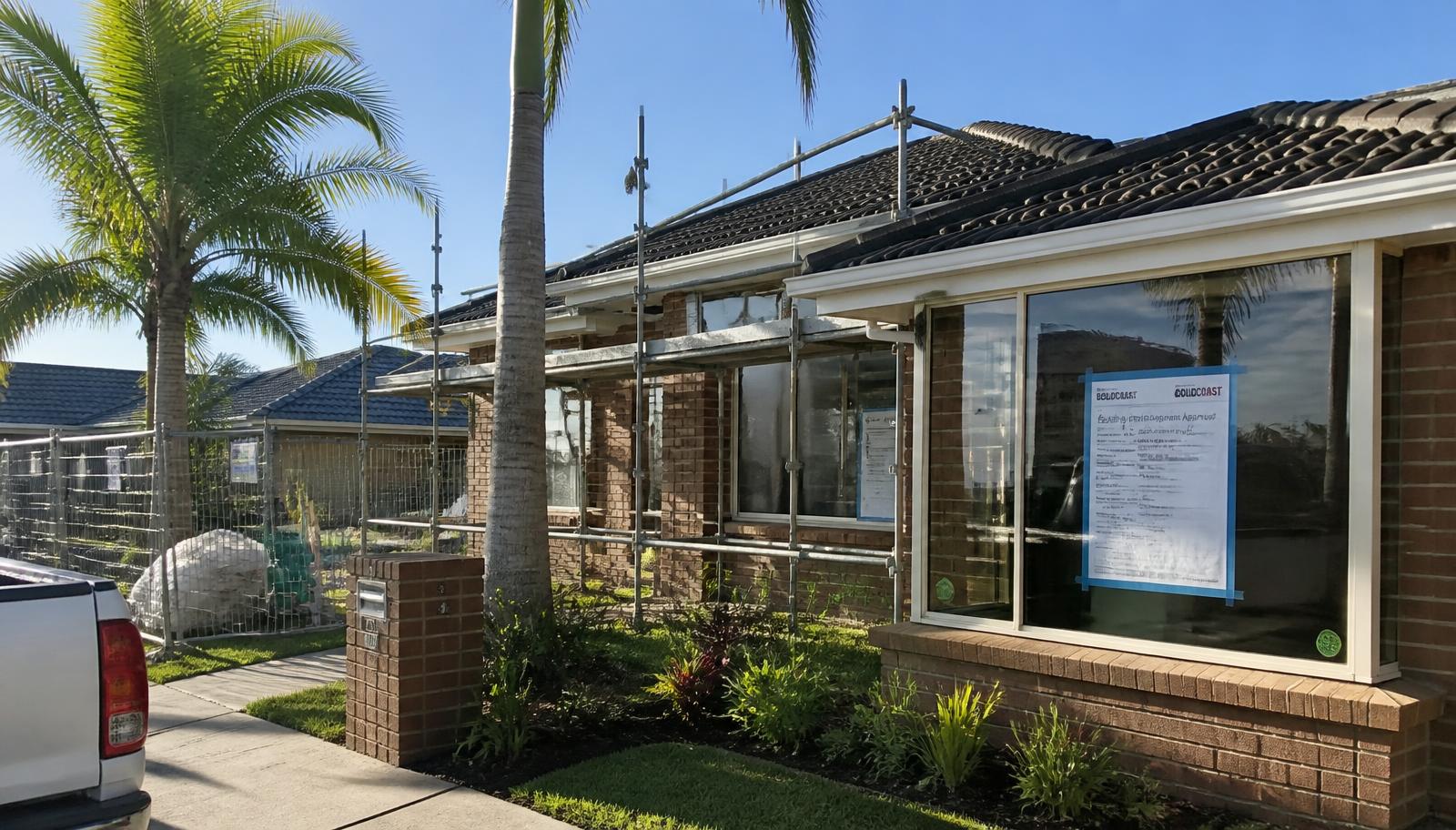
A building certifier (private or council) charges for assessing and inspecting the work - budget $1,200-$4,000 for a renovation requiring a building approval, more for larger extensions. If your project needs development approval rather than just building approval (common for extensions close to boundaries, secondary dwellings, or anything triggering a town planning trigger under the City of Gold Coast or Logan City Council planning schemes), add council application fees which can run from a few hundred dollars to several thousand, plus infrastructure charges in some cases. Energy efficiency reports (required under the National Construction Code for most habitable extensions) typically cost $400-$900. None of these fees are optional extras a builder is inflating your price with - they are statutory or professional costs that exist regardless of who builds your job.
Surveys, soil tests and site investigations
Extensions and new decks on sloping or reactive sites need a site survey ($600-$1,500) and often a geotechnical/soil test ($700-$1,800) to confirm footing design. If your home was built before 1990, an asbestos audit is worth commissioning before demolition begins - a pre-purchase-style asbestos and hazardous materials report runs $400-$900, and if asbestos is found, licensed removal and disposal can add $1,500-$6,000+ depending on the extent and location of the material.
Ask each builder or draftsperson to itemise which soft costs are included in their quote and which sit outside it. Two quotes that look $10,000 apart on paper can be identical once you add back the certifier, engineering and energy report fees one builder bundled in and the other didn't.
Site costs: running the job safely and legally
Access, scaffolding and craneage
Narrow canal-front blocks in Broadbeach and Southport, steep sites in Burleigh Heads and Mudgeeraba, and tight infill lots through Logan often need scaffolding ($1,000-$4,000 for a typical two-storey job for several weeks), and occasionally craneage to lift trusses or materials over a house where there's no side access - crane hire for a half-day lift can be $1,500-$3,500. If your builder can't get a truck or excavator down the side of the house, expect an access-related site cost that a straightforward suburban block in Coomera or Upper Coomera would never incur.
Waste, amenities and temporary services
Skip bins and tip fees for a kitchen or bathroom renovation typically run $800-$2,500 across the job; a full home renovation or extension can require multiple large bins and $3,000-$6,000 in total waste costs. Add a portable toilet hire ($150-$300/week) if the house isn't liveable, temporary fencing for safety and security ($300-$1,000), and site power/water connection or generator hire if services aren't readily available. Protection of existing floors, driveways and landscaping during the build - ply sheeting, corflute, fencing off garden beds - is inexpensive individually but adds up to a genuine line item, often $500-$1,500.
Disruption costs: the cost of living through it
This is the category homeowners underestimate most. If your kitchen is out of action for four to six weeks, you'll spend more on takeaway and eating out than you expect - realistically $50-$150 a week extra for a family. If a bathroom renovation leaves you without a shower, a short hotel stay or gym membership for showers is a real cost. Full home renovations or major extensions sometimes require temporary accommodation for weeks or months - rental overlap alone (paying rent or a short-term let while still holding your mortgage) can be the single largest hidden cost of a whole-house project, often $3,000-$15,000+ depending on duration and location.
Storage for furniture and belongings moved out of the work zone runs $80-$250/month depending on volume. Pets sometimes need boarding during noisy demolition phases. And there's a real cost in commuting further to a temporary rental in Helensvale or Nerang while your Robina or Ashmore home is unliveable. None of this appears on a builder's quote because it isn't the builder's cost to price - it's yours to plan for.
Unexpected discoveries once walls and floors open up
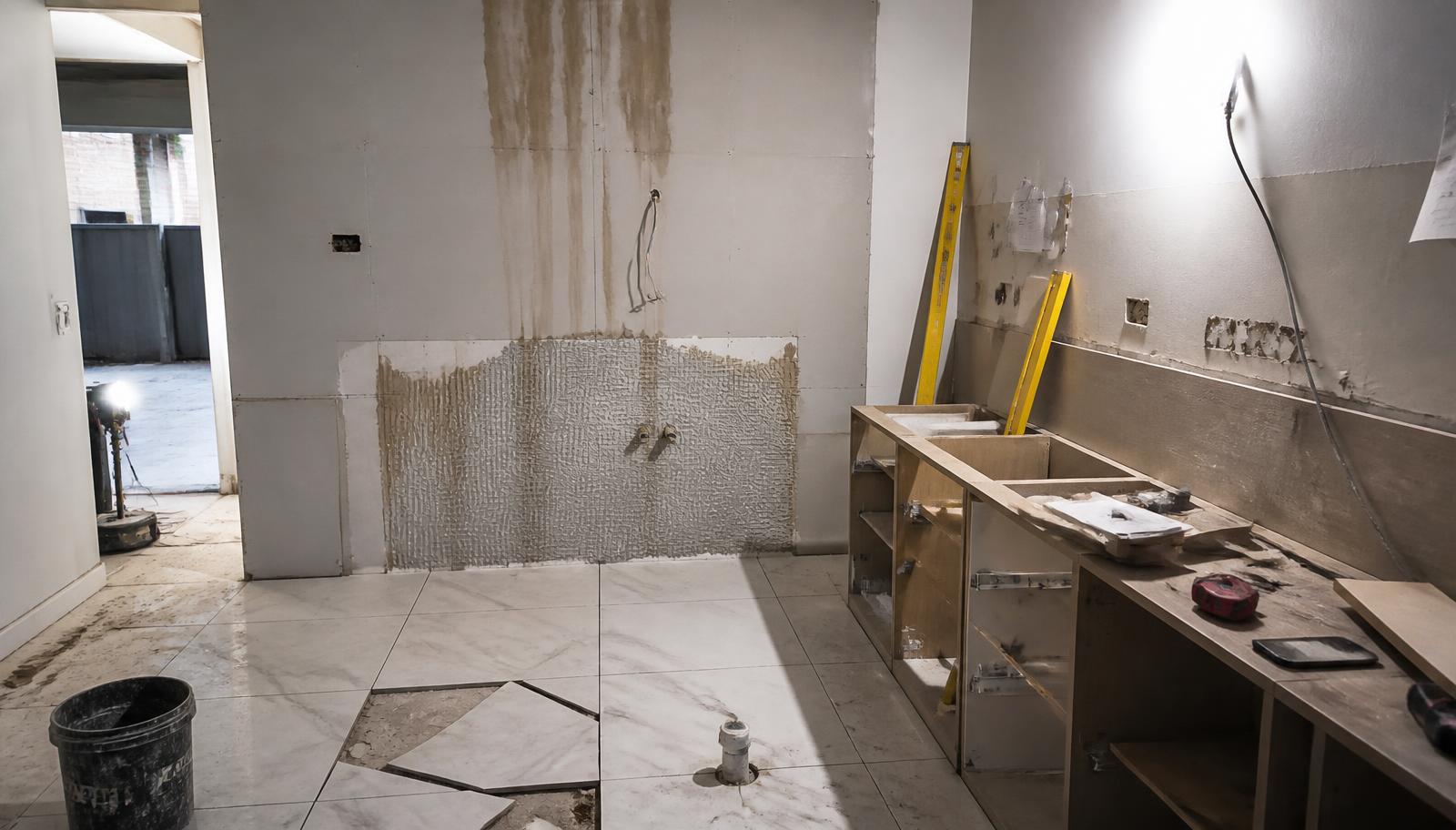
Older SEQ homes - particularly 1960s-1980s brick veneer and Queenslanders on older SEQ streets - regularly reveal problems only once demolition starts. A reputable QBCC licensed contractor will flag these as variations rather than absorbing them silently, which is exactly what you want, but it means your contingency needs to cover them.
| Discovery | Typical cost range | How common |
|---|---|---|
| Timber rot in wall frames or subfloor | $800 - $6,000 | Common in homes 30+ years old |
| Termite damage to structural timber | $1,500 - $15,000+ | Common in SEQ, especially timber-framed homes |
| Non-compliant or undersized wiring | $1,200 - $5,000 | Common pre-1990 electrical |
| Undersized switchboard needing upgrade | $800 - $2,500 | Frequent when adding circuits |
| Failed waterproofing behind old tiles | $1,500 - $4,000 | Very common in bathroom reno |
| Uneven or cracked slab needing levelling | $1,000 - $8,000 | Common in older or reactive-soil homes |
| Lead paint in pre-1970 homes | $500 - $3,000 (safe removal) | Common in homes built before 1970 |
A well-drafted renovation contract includes a provision for the builder to inspect and photograph conditions once walls, floors or ceilings are opened, with any rectification priced as a documented variation before work proceeds. This protects you from being told about a problem only after it's been fixed and billed.
Finishing costs people forget to budget
The last 10% of a renovation is where budgets blow out on 'small' items that aren't actually small. Tapware and door hardware upgrades from builder-grade to something you'll be happy looking at for fifteen years can add $1,500-$5,000 across a kitchen and bathroom. Appliance delivery, installation and disposal of old units often costs $300-$800 on top of the appliance price itself. A splashback, if not included in your kitchen quote, is commonly $800-$2,500. Window furnishings (blinds, curtains) for a new or altered room run $150-$600 per window. Painting doesn't stop at the new work - matching an extension's paint to the rest of the house, or repainting adjoining rooms disturbed by the build, is a common $2,000-$6,000 add-on. Landscaping make-good after site access and trenching, and a final professional clean, round out a list that can total $6,000-$15,000 on a mid-size project if none of it is planned for in advance.
Holding and finance costs
If you're using a construction loan, you'll pay interest on funds progressively drawn down as each stage completes - this interest is a real cost that isn't in your builder's contract price. Progress payment timing also matters: if your loan progress payments lag behind your builder's claim dates, you may need a short-term buffer of cash to bridge the gap. Building insurance premiums often increase during construction (contract works insurance is typically arranged by your builder and its cost included in the contract, but check), and if you're renovating an investment property, rates, land tax and body corporate levies keep accruing regardless of whether the property is earning rent. For general guidance on managing loan drawdowns and construction finance, Moneysmart (moneysmart.gov.au) is a useful independent starting point.
GST and contingency: the two numbers everyone gets wrong
Always confirm whether quotes you're comparing are GST-inclusive or exclusive - a $50,000 quote excluding GST is actually a $55,000 job, and mixing GST-inclusive and exclusive quotes when comparing builders is one of the most common budgeting errors homeowners make. The Australian Taxation Office (ato.gov.au) has guidance on GST treatment for residential building work if you want to confirm the detail for your situation.
Contingency is not optional padding - it's the mechanism that absorbs the discoveries and scope changes covered above. As a guide, budget 10% contingency on a straightforward like-for-like renovation with no structural change, 15% on a renovation involving some structural work or an older home, and 20%+ on a full extension, a heritage-listed property, or any home built before 1980 where you genuinely don't know what's behind the walls until they're opened.
A fully-loaded budget: three real project sizes
| Budget tier | Construction cost | Soft + site costs | Disruption + finishing | Contingency (15%) | Realistic total |
|---|---|---|---|---|---|
| $60,000 (bathroom + laundry reno) | $60,000 | $3,000 - $5,500 | $1,500 - $3,000 | $9,000 | $73,500 - $77,500 |
| $150,000 (kitchen + living extension) | $150,000 | $9,000 - $16,000 | $6,000 - $12,000 | $22,500 | $187,500 - $200,500 |
| $400,000 (whole-home renovation) | $400,000 | $24,000 - $40,000 | $15,000 - $30,000 | $60,000 | $499,000 - $530,000 |
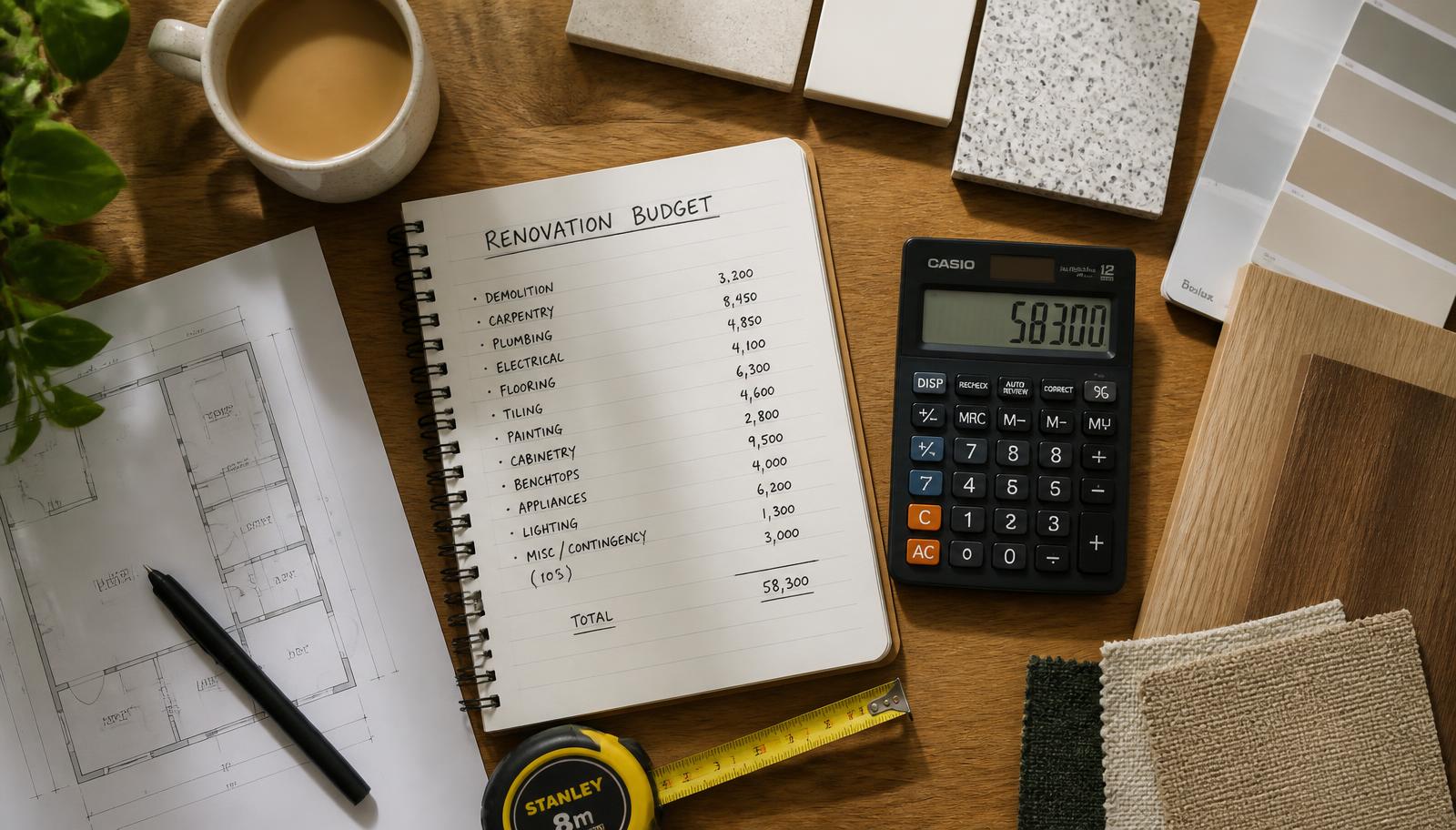
These figures are genuinely indicative and every project needs its own site inspection and written quote - a Hope Island canal home with a difficult access point will sit at the top of these ranges, while a straightforward Pimpama or Springfield block on flat, easy-access land will sit at the bottom. The point of the table isn't the exact numbers; it's the proportion. Soft, site, disruption and finishing costs plus contingency routinely add 20-30% on top of the construction figure, and that's the gap that catches homeowners who only budgeted the builder's headline price.
How to build a realistic total-project budget: step by step
- Get a written scope of works from your builder and confirm exactly what it includes and excludes - ask specifically about certifier fees, engineering, energy reports and waste disposal.
- Get separate quotes for any soft costs not included: draftsperson or architect, structural engineer, land surveyor, soil test, asbestos audit if the home pre-dates 1990.
- Call your local council (City of Gold Coast or Logan City Council) or check business.qld.gov.au to confirm which approvals apply and what the application and inspection fees will be.
- Estimate site costs based on your specific block: access difficulty, need for scaffolding or craneage, number of skip bins likely required, and whether temporary power, water or amenities are needed.
- Map out your disruption plan - where you'll live, eat and shower during each phase, and price temporary accommodation, storage and eating-out costs for the realistic build duration, not the optimistic one.
- Add a finishing allowance for tapware, appliances, splashback, window furnishings, matching paint and a final clean - even if you plan to keep this modest, budget for it explicitly.
- Calculate holding costs: construction loan interest during the build period, any bridging finance needed between progress payments, and insurance or holding costs if the property is tenanted or vacant.
- Apply contingency of 10-20% depending on the age of the home and the extent of structural work, calculated on the full total above, not just the construction figure.
- Add all of these together to get your real total-project budget, then compare that number - not the builder's quote alone - to what you can actually afford to spend.
Budget-building checklist
- Written builder quote with inclusions and exclusions clearly listed
- Draftsperson/architect and engineering fees quoted separately
- Council approval pathway confirmed and fees estimated
- Certifier fees included in someone's quote, not assumed
- Site costs estimated for your specific block and access
- Waste, amenities and site protection costs allowed for
- Disruption plan costed: accommodation, storage, eating out
- Finishing allowance set aside for tapware, appliances, paint-matching
- Construction loan interest and progress payment timing understood
- GST treatment confirmed on every quote being compared
- Contingency of 10-20% applied to the full total, not just construction
Pre-quote information checklist to give your builder
- Age of the home and any known past renovations or extensions
- Any known issues: past leaks, termite treatment history, subfloor access
- Whether the home has asbestos-era cladding or sheeting (pre-1990)
- Site access constraints: side access width, slope, neighbouring fences
- Your intended living arrangements during the build
- Whether the property is owner-occupied, tenanted or about to be sold
- Your finance structure - cash, construction loan, or a mix
- Your must-haves versus nice-to-haves, ranked, so scope can flex if budget is tight
Not sure what your renovation really costs once every line item is counted? Get a fixed-price quote that spells out inclusions, exclusions and likely site costs upfront.
Get a fixed-price quoteHow Orange Projects prices the whole job, not just the build
We work across the Gold Coast and Logan on home renovations, kitchen and bathroom renovations, extensions, decks, flooring and insurance repairs, and we've quoted enough jobs in Southport, Broadbeach, Robina, Burleigh Heads, Carrara and Varsity Lakes to know where hidden costs typically hit each area. Our quotes spell out what's included and flag the soft and site costs you'll need to budget for separately, and we document any discoveries once walls or floors open up as priced variations before proceeding - not surprises on your final invoice. If you want a rough indicative figure before a full site visit, our AI Renovator tool is a useful starting point for shaping a realistic budget conversation.
Get an instant indicative estimate for your renovation before you commit to a detailed quote.
Try the AI Renovator