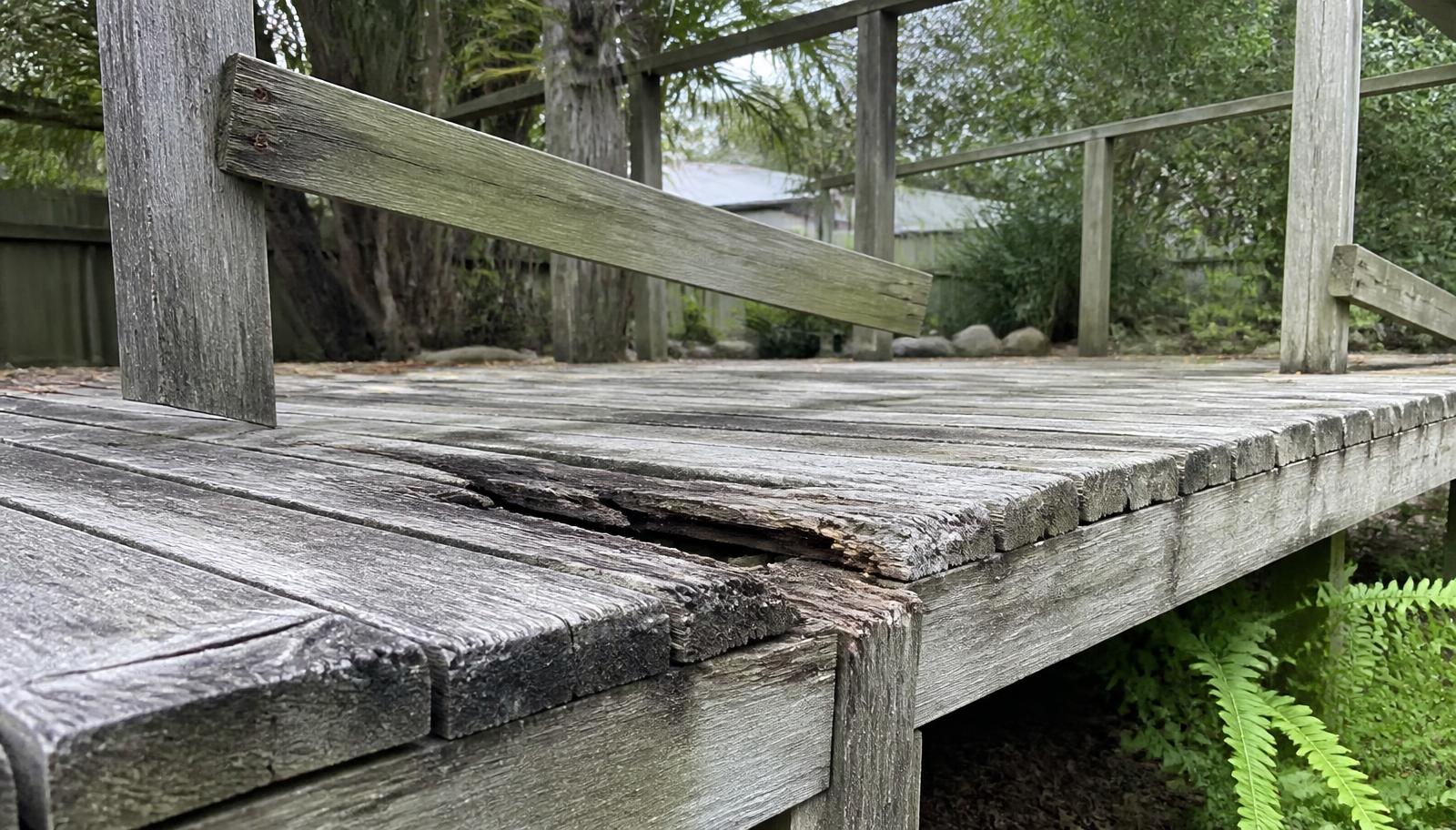
A timber deck can look perfectly fine on top while the frame underneath is quietly failing — and by the time it feels obviously unsafe, the damage is usually extensive. This guide walks through the ten warning signs that separate a straightforward repair from a deck that genuinely needs replacing, including a 20-minute DIY inspection you can do this weekend, the safety and insurance implications of getting it wrong, and how Queensland's subtropical and coastal climate accelerates every one of these failure modes.
Replace, don't repair, when you find spongy boards over more than a third of the deck, rot or termite damage in bearers, joists or post stumps, rusted or failed post stirrups, sway in the frame, or a handrail that fails the 1m drop or 125mm gap rules. Isolated board damage on a sound frame is usually repairable; frame and connection failures are structural and mean the whole deck needs rebuilding for safety and insurance reasons.
Why timber decks in South East Queensland fail faster than you'd expect
A timber deck built to last 25 years on the Gold Coast or Logan often shows serious structural problems well before the 15-year mark, and the culprit is almost always the subtropical climate rather than poor original workmanship. Humidity sits above 70% for much of the year, summer storms drive moisture into end grain and joints, and along the coastal strip from Palm Beach through Burleigh Heads to Broadbeach, salt-laden air accelerates corrosion of nails, screws, bolts and galvanised post stirrups. UV exposure bleaches and dries the timber surface while moisture cycles underneath keep the structural members damp, a combination that speeds up fungal decay in exactly the members you can't see from the top.
Inland areas around Nerang, Robina, Carrara and Mudgeeraba escape the worst of the salt air but still see heavy wet-season rainfall and high ground moisture under low-clearance decks, so rot at bearer ends and post bases is common there too. Understanding which of the ten warning signs below point to cosmetic wear versus genuine structural failure is the difference between a $600 board swap and a full rebuild, and it's also the difference between a deck that's safe for a barbecue with twenty guests and one that's a genuine liability.
The 10 warning signs a deck needs replacing, not patching
1. Spongy or bouncing boards underfoot
If the decking flexes noticeably or feels soft when you walk across it, moisture has usually penetrated the board and is beginning to break down the timber fibres from within. A single soft board near a planter or downpipe can be a localised issue, but sponginess spread across multiple boards, especially in a pattern that follows the joist lines underneath, usually means the joists themselves are compromised, not just the decking on top.
2. Cupping, splitting and excessive checking
Some surface checking (small longitudinal cracks) is normal timber movement and not a safety issue on its own. Cupping, where a board's edges curl upward, indicates the underside is absorbing more moisture than the top can release, usually because airflow underneath the deck is restricted. Deep splits that run the full length of a board, particularly near fixing points, weaken the board's ability to hold a screw and are a precursor to the board breaking underfoot.
3. Nail pop and loose or corroded fixings
Nail heads lifting proud of the board surface are a classic sign of timber swelling and shrinking through repeated wet-dry cycles. It looks minor, but every popped nail is a fixing point that's no longer doing its job, and a deck fixed predominantly with nails rather than screws (common in older Queensland decks) will progressively lose holding strength across the whole structure.
4. Rot at bearer and joist ends
The ends of bearers and joists, where they sit in or on top of post stirrups, are the highest-risk rot zone on any deck because water tracks along the top of the timber and pools exactly where the connection hardware traps moisture against end grain. A screwdriver pushed into the end of a bearer that sinks in more than a few millimetres without resistance indicates decay has already progressed well into the member.
5. Fungal decay and white or brown rot
White rot leaves timber stringy, light in colour and spongy; brown rot leaves it dark, crumbly and cracked into cube-like pieces. Either pattern found on structural members, rather than just decking boards, means that section of frame has lost load-bearing capacity and needs to be cut out and replaced at minimum, and often signals it's time to assess the whole subframe.
6. Termite and borer damage
South East Queensland has some of the highest subterranean termite pressure in the country, and timber decks built hard against the ground or against a house wall are prime targets. Hollow-sounding timber when tapped, small kick-out holes, or mud shelter tubes running up a post are signs of active or past termite activity. Any termite damage in structural members warrants a full pest inspection of the deck and the adjoining house frame before any repair work proceeds.
7. Rusted, bent or failed post stirrups and bolts
Galvanised post stirrups and bolted connections are the deck's structural backbone, and in coastal suburbs like Hope Island, Broadbeach and Palm Beach, salt air can corrode unprotected steel hardware within 10-15 years even when the timber itself still looks reasonable. Rust staining running down a post, a stirrup that's visibly thinned or perforated, or a bolt that turns freely without resistance are all signs the connection can no longer be trusted.
8. Noticeable movement or sway in the frame
Stand on the deck with a few other people and gently rock side to side, or push against a corner post. Any lateral sway, or a sensation of the whole structure moving rather than just the boards flexing, indicates the bracing, post connections or footings have failed and the deck no longer meets the structural performance it was designed for.
9. Handrail and balustrade failing safety requirements
Under the National Construction Code and Queensland's balustrade requirements, any deck edge more than 1m above the ground or floor below must have a compliant balustrade, with gaps no wider than 125mm and a 1m minimum height. A handrail that wobbles, has since developed gaps wider than 125mm through timber shrinkage, or was never installed to begin with on an older deck is both a safety hazard and a compliance issue that surfaces when you sell the property or lodge an insurance claim.
10. Ledger board and flashing failure at the house junction
The ledger board bolts the deck frame to the house and is one of the most common failure points nationally, because water tracks off the house wall and behind inadequate or missing flashing, rotting the ledger from behind where it's invisible during a casual inspection. Staining on the wall cladding above the deck, a gap opening up between the deck and the house, or visible rot where the ledger meets the wall are all signs this critical connection needs urgent professional assessment.
Not sure which category your deck falls into? Get a professional structural assessment and a fixed-price quote for repair or rebuild.
Get a fixed-price quoteRepair vs replace: a decision table
| Symptom | Likely cause | Repair or replace | Indicative cost (SEQ, 2026) |
|---|---|---|---|
| 1-2 spongy boards | Localised moisture ingress | Repair — replace boards | $400-$900 |
| Spongy boards across >30% of deck | Widespread joist decay | Replace frame | $8,000-$20,000+ |
| Popped nails, boards otherwise sound | Fixing fatigue | Repair — re-fix or re-screw | $500-$1,500 |
| Rot at 1-2 bearer ends | Poor drainage/flashing at that point | Repair — sister or splice bearer | $1,200-$3,000 |
| Rot at multiple bearer/joist ends | Systemic moisture, ventilation or slope issue | Replace subframe | $6,000-$18,000 |
| Rusted individual stirrup | Localised corrosion, often coastal | Repair — replace stirrup | $300-$700 per post |
| Widespread stirrup/bolt corrosion | Age plus coastal salt exposure | Replace frame | $8,000-$22,000 |
| Termite damage confirmed | Subterranean termite activity | Replace affected members after treatment | Varies — pest treatment plus $2,000-$15,000+ |
| Frame sway or movement | Failed bracing or footings | Replace frame | $8,000-$25,000 |
| Non-compliant or failing balustrade | Age, shrinkage, or never compliant | Repair or replace balustrade | $1,500-$6,000 |
| Ledger board rot | Flashing failure at house junction | Replace ledger and flashing (frame-dependent) | $1,500-$5,000+ |
Decking material lifespan in Gold Coast and Logan coastal conditions
| Material | Typical lifespan (coastal) | Typical lifespan (inland) | Key failure mode |
|---|---|---|---|
| Treated pine (H3/H4) decking boards | 10-15 years | 15-20 years | Surface checking, board-level rot |
| Hardwood decking (spotted gum, merbau) | 20-30 years | 25-35 years | Cupping, splitting, fixing failure |
| Treated pine subframe (bearers/joists) | 12-18 years | 18-25 years | End-grain rot at connections |
| Hardwood subframe | 25-35 years | 30-40 years | Rot at bearer/joist ends over time |
| Galvanised steel post stirrups/bolts | 10-20 years | 20-30 years | Salt-air corrosion, rust perforation |
| Composite decking boards | 20-30 years (boards) | 25-30 years (boards) | Board fade/wear; frame beneath still timber or steel |
A common mistake is resurfacing an old deck with new composite boards while leaving the original timber subframe untouched. If the bearers, joists and post connections are already showing rot or corrosion, new boards on top only mask the problem and the frame will still need replacing within a few years.
The 20-minute DIY deck inspection walkthrough
You don't need trade tools to get a reasonable read on your deck's condition before calling in a QBCC-licensed carpenter. This walkthrough takes about 20 minutes and covers the checks that reveal most structural problems.
- Screwdriver probe test: push a flat-head screwdriver firmly into the end grain of every accessible bearer, joist and post at ground level. Sound timber resists the point; if it sinks in more than 5-10mm easily, decay is present.
- Deflection test: stand in the centre of each bay between joists and bounce gently. Noticeable give or a soft, springy feel indicates joist or board weakness in that area.
- Sway test: with a helper, grip a corner post and rock the deck side to side and front to back. Any visible movement at ground level indicates a footing or bracing problem.
- Subframe crawl: get underneath (or use a torch and mirror if clearance is tight) and visually check every bearer end, joist end and post base for staining, fungal growth, termite mud tubes or missing/rusted fixings.
- Fixings check: look along the decking board lines for popped nails, and check bolted connections at posts and the ledger board for rust bleed or looseness by hand.
- Balustrade check: push firmly on the handrail at several points and measure the largest baluster gap with a tape measure to confirm it's under 125mm.
- Ledger and flashing check: inspect the wall above and behind the deck-to-house junction for staining, gaps, or visible rot, and check that flashing is present and intact where visible.
Deck inspection checklist
- Screwdriver probe test on all accessible bearers, joists and posts
- Deflection/bounce test across every bay
- Sway test on corner and mid-span posts
- Visual check of subframe for rot, staining and termite activity
- Check all visible fixings for rust, popping or looseness
- Measure balustrade gaps and test handrail firmness
- Inspect ledger board and house-wall flashing
- Check post base connection to footing/stump for movement
- Note any pooling water or poor drainage under the deck
- Photograph any defects found for your builder or insurer
The safety and liability angle for entertaining and pool decks
A deck that's marginal for two people having a coffee can become genuinely dangerous once you load it with twenty guests for a birthday party, a full outdoor dining setting, or a spa. This matters most for the large entertaining decks common around Burleigh Heads, Hope Island and Broadbeach, and for pool decks where the timber sits in a near-permanently damp, chlorinated environment that accelerates both timber decay and metal corrosion. If a deck collapses or a balustrade fails and someone is injured, the property owner can be held liable, and an insurer is entitled to investigate whether the deck was maintained to a reasonable standard and whether any prior defects were known and ignored. Keeping dated photos of inspections and repairs is a straightforward way to demonstrate reasonable care.
If your deck is at a rental property, Queensland's minimum housing standards and general safety obligations mean a landlord can't reasonably leave a deck with known structural defects in service. Get it assessed and documented as soon as any of the ten warning signs appear.
QBCC and insurance implications of a deck failure
Deck construction and structural repair work above certain thresholds requires a QBCC-licensed contractor, and using an unlicensed operator for structural deck work can void your home and contents insurance if something later goes wrong, because insurers routinely check whether structural work was licensed and permitted. If a deck collapses and investigation shows known defects were left unrepaired, an insurer may decline or reduce a claim on the basis the damage or injury resulted from a lack of reasonable maintenance rather than a sudden, unforeseen event. For decks damaged by storms or flooding rather than gradual decay, see our guide on the first steps after storm damage for how the insurance claims process typically works.
When repair genuinely beats replacement
Not every ageing deck needs a full rebuild, and a good carpenter will tell you when repair is the sensible, cost-effective option rather than upselling a new build. Repair generally makes sense when the subframe — bearers, joists, posts and their connections — is confirmed sound by inspection and the problems are limited to the decking boards, balustrade, or a small number of isolated fixings or connections. In that scenario, replacing boards, re-screwing loose fixings, sistering a single damaged joist, or swapping a corroded stirrup can extend the deck's usable life by another decade or more for a fraction of full rebuild cost.
When the subframe can be salvaged
A hardwood subframe that's still structurally sound but sitting under tired treated-pine decking is a common and genuinely good candidate for board replacement only — you keep the more expensive, longer-lasting structural timber and refresh the wearing surface. The same logic applies to steel-framed decks where the frame passes inspection but the timber decking has reached end of life.
When a full rebuild is the only responsible option
Once rot, termite damage or corrosion has spread through multiple structural members, or the frame itself shows sway and deflection under normal loads, patching individual members is a false economy — you'll be back doing further repairs within a year or two, and each additional repair on a failing structure carries genuine safety risk in the meantime. In these cases, a full rebuild with a fresh, correctly flashed frame is the only option that resets the clock and removes the liability.
Want a visual concept for your new deck before committing to a rebuild? Explore layout and material options in minutes.
Try the AI RenovatorMaintenance that extends deck life once it passes inspection
Ongoing deck maintenance checklist
- Re-oil or re-stain timber decking every 12-18 months in coastal locations, 18-24 months inland
- Clear leaf litter and debris from between boards and under the deck every season
- Check and clear gutters and downpipes near the deck before each wet season
- Hose off salt residue after storms if within a few kilometres of the coast
- Trim back garden beds and vegetation to maintain airflow under and around the deck
- Re-tighten any hand-accessible bolted connections annually
- Arrange a professional termite inspection every 12 months in high-risk SEQ suburbs
- Repaint or touch up exposed steel fixings showing early rust before it spreads
Getting a professional assessment across the Gold Coast and Logan
If your inspection turns up two or more of the ten warning signs, or you're not confident reading what you find underneath the deck, it's worth getting a QBCC-licensed carpenter out for a proper structural assessment before your next big gathering. We inspect and repair or rebuild decks across Robina, Southport, Ashmore, Varsity Lakes, Coomera, Upper Coomera and Pimpama on the Gold Coast, and across Logan including Springwood, Shailer Park and Beenleigh, and we'll give you an honest repair-vs-replace recommendation with a fixed-price quote rather than defaulting to the most expensive option.
Get a professional deck inspection and a fixed-price repair or rebuild quote from a QBCC-licensed team.
Get a fixed-price quote