
Gold Coast Carpentry Guide
What carpenters actually do, how structural and finishing work differ, what licensing is required in Queensland, what drives cost, and how to brief a carpentry job so the quotes you receive are comparable.

Carpentry on the Gold Coast covers two broad categories: structural work such as framing, beams, subfloors and decks, and finishing work such as doors, skirting, architraves, cladding and built-in joinery. Work over the QBCC threshold must be carried out by a licensed contractor, and in this climate material and fixing selection matters as much as the workmanship.
- Structural carpentry
- Framing, beams, subfloors, decks, wall removal, structural repairs
- Finishing carpentry
- Doors, skirting, architraves, cladding, feature and media walls
- Licensing
- QBCC licence required for building work above the statutory threshold
- Local factor
- Salt air, humidity and UV drive timber species and fixing class selection
Overview
Carpentry is the trade that touches nearly every renovation, repair and maintenance job in a Gold Coast home, and it is also the trade people find hardest to compare quotes for - because two carpenters can price the same room and be describing entirely different scopes. This guide sets out how the work is actually categorised, what has to be licensed, what conditions on the Gold Coast do to timber, and where the money goes on a typical job. It links through to our individual service pages where you want the detail on a specific job. If you already know what you need, the fastest route is our carpentry services page or a quote request.
What's included
- Structural framing, beams and load transfer
- Subfloor, bearer and joist repairs
- Wall removal and internal layout changes
- Deck, pergola and outdoor structure construction and repair
- Door supply, installation and repair
- Skirting, architrave and internal trim
- Timber and composite cladding
- Feature walls, media walls and built-in joinery
- Timber, hybrid and engineered flooring installation
- Commercial carpentry, fitouts and make-good works
Structural versus finishing carpentry
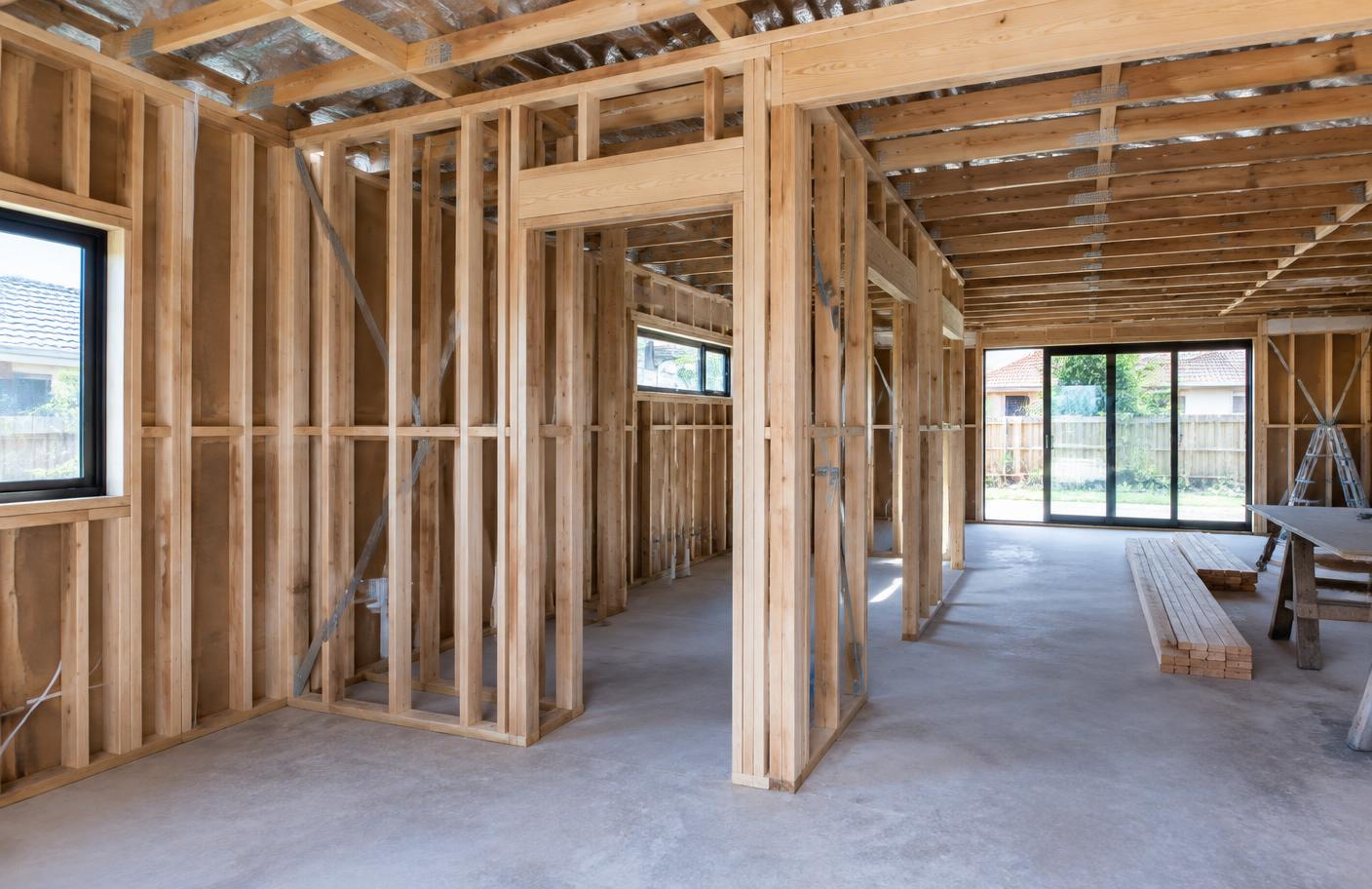
Structural carpentry is anything holding the building up or transferring load - wall and roof framing, floor structures, beams over openings, deck substructures and posts. It requires engineering input where load paths change, and it is where mistakes are expensive and sometimes dangerous. Finishing carpentry is what you look at every day - doors that shut cleanly, mitres that stay closed, skirting with a consistent scribe, cladding with even shadow lines. It rarely fails structurally but it is the work that determines whether a renovation looks professionally finished or not. Most jobs need both. A wall removal is structural until the beam is in, then becomes a finishing job for the ceiling, cornice, flooring and trim - and quotes that only cover the first half are the single most common reason renovation budgets blow out.
Licensing in Queensland - what to check
Building work in Queensland above the statutory value threshold must be carried out by a QBCC-licensed contractor, and the licence must cover the class of work being performed. This matters beyond compliance: work done by an unlicensed contractor is not covered by the Queensland Home Warranty Scheme, which is the protection that steps in if a contractor fails to complete or rectify work. You can check any contractor's licence on the QBCC's online register. Ask for the licence number, check the class covers your work, and confirm public liability insurance. Orange Projects holds QBCC Licence No. 15620733.
What the Gold Coast climate does to timber
Three local conditions drive most of the specification decisions we make. Salt air within a few kilometres of the coast and around the canal systems corrodes fixings, so stainless or correctly class-rated fixings are not an upgrade here, they are a requirement. High humidity keeps timber moisture content elevated, so untreated timber in a poorly ventilated position decays much faster than the same material inland. And intense UV degrades unprotected surfaces and coatings quickly. The practical consequences run through our rotten timber repairs, deck repairs and subfloor repairs pages, which are the three jobs these conditions generate most often.
What drives carpentry cost
Labour intensity rather than material cost usually decides the number. A straight run of skirting in a new build is fast; the same lineal metres in a 1970s home with out-of-square walls and multiple returns takes considerably longer. Access matters - a second-storey balcony repair carries costs a ground-level deck does not. So does the unknown: repair work on hidden structure often can only be fully scoped once linings or boards come off. Our carpentry cost guide breaks the variables down. We do not publish flat rates for structural work because doing so would mean either padding every quote or issuing variations later.

How to brief a carpentry job so quotes are comparable
Write down the finished result rather than the method. "Open the kitchen to the living room, ceiling flat throughout, existing flooring to continue through the old wall line" tells every carpenter the same thing. "Remove wall" does not. Say what you want in writing about make-good specifically: patching, cornice, flooring, skirting and painting. Confirm whether rubbish removal and any engineering or certification fees are included. Then compare the scopes before comparing the prices - a cheaper quote is often a smaller scope.
Why choose Orange Projects
Licensed and insured
Orange Projects holds QBCC Licence No. 15620733 and carries the insurance needed for our work.
Local experience
We understand Gold Coast homes, coastal conditions and the practical details that affect local building work.
Clear written quotes
You receive an itemised quote after we inspect the site and confirm the scope.
Careful workmanship
Our carpenters and trade partners focus on solid work, clean details and a tidy site.
One point of contact
We coordinate the work and keep you informed from the first visit through to handover.
Straight answers
We explain the work, timing and decisions in plain language.
Suitable materials
We choose materials that suit the job and local weather conditions.
Workmanship support
We stand behind our work and explain the warranties that apply to your project.
Our process
- 1
Site inspection
We attend the property, inspect the actual condition rather than working from photos alone, and talk through what you want the finished result to be. Bring any reports, strata approvals or insurance paperwork you already have.
- 2
Written fixed-price quote
You receive an itemised quote covering labour, materials, rubbish removal and any engineering or certification required. Where the full extent of damage can only be confirmed once linings or decking boards come off, we say so up front and quote the investigative stage separately rather than hiding it in an allowance.
- 3
Approvals and scheduling
Where certification, an engineer's design or body corporate approval is needed, we organise it and book the works into a dated program so you know which days we are on site.
- 4
Carry out the works
Protected floors, dust control, tidy site each afternoon and photo updates as we go. Occupied homes, tenanted properties and trading businesses are all worked around rather than shut down where possible.
- 5
Handover
Final walkthrough, defect check, invoice and any documentation - engineering certificates, Form 16s, product warranties - handed over with the job.
Areas we service on the Gold Coast
Servicing the Gold Coast and Logan, including these Gold Coast areas:
- Robina
- Burleigh Heads
- Mermaid Waters
- Helensvale
- Hope Island
- Coomera
- Southport
- Broadbeach
- Palm Beach
- Miami
- Varsity Lakes
- Ashmore
We also service Logan:
Gold Coast Carpentry Guide by suburb
Find clear local information about gold coast carpentry guide, site access and common project needs.
Gold Coast
- Gold Coast Carpentry Guide Arundel
- Gold Coast Carpentry Guide Ashmore
- Gold Coast Carpentry Guide Benowa
- Gold Coast Carpentry Guide Biggera Waters
- Gold Coast Carpentry Guide Bilinga
- Gold Coast Carpentry Guide Bonogin
- Gold Coast Carpentry Guide Broadbeach
- Gold Coast Carpentry Guide Broadbeach Waters
- Gold Coast Carpentry Guide Bundall
- Gold Coast Carpentry Guide Burleigh Heads
- Gold Coast Carpentry Guide Burleigh Waters
- Gold Coast Carpentry Guide Carrara
- Gold Coast Carpentry Guide Chevron Island
- Gold Coast Carpentry Guide Clear Island Waters
- Gold Coast Carpentry Guide Coolangatta
- Gold Coast Carpentry Guide Coomera
- Gold Coast Carpentry Guide Currumbin
- Gold Coast Carpentry Guide Currumbin Valley
- Gold Coast Carpentry Guide Currumbin Waters
- Gold Coast Carpentry Guide Elanora
- Gold Coast Carpentry Guide Gaven
- Gold Coast Carpentry Guide Gilston
- Gold Coast Carpentry Guide Helensvale
- Gold Coast Carpentry Guide Highland Park
- Gold Coast Carpentry Guide Hope Island
- Gold Coast Carpentry Guide Isle of Capri
- Gold Coast Carpentry Guide Jacobs Well
- Gold Coast Carpentry Guide Kirra
- Gold Coast Carpentry Guide Labrador
- Gold Coast Carpentry Guide Main Beach
- Gold Coast Carpentry Guide Maudsland
- Gold Coast Carpentry Guide Mermaid Beach
- Gold Coast Carpentry Guide Mermaid Waters
- Gold Coast Carpentry Guide Merrimac
- Gold Coast Carpentry Guide Miami
- Gold Coast Carpentry Guide Molendinar
- Gold Coast Carpentry Guide Mudgeeraba
- Gold Coast Carpentry Guide Nerang
- Gold Coast Carpentry Guide Nobby Beach
- Gold Coast Carpentry Guide Ormeau
- Gold Coast Carpentry Guide Oxenford
- Gold Coast Carpentry Guide Pacific Pines
- Gold Coast Carpentry Guide Palm Beach
- Gold Coast Carpentry Guide Paradise Point
- Gold Coast Carpentry Guide Paradise Waters
- Gold Coast Carpentry Guide Parkwood
- Gold Coast Carpentry Guide Pimpama
- Gold Coast Carpentry Guide Reedy Creek
- Gold Coast Carpentry Guide Robina
- Gold Coast Carpentry Guide Runaway Bay
- Gold Coast Carpentry Guide Sanctuary Cove
- Gold Coast Carpentry Guide Southport
- Gold Coast Carpentry Guide Sovereign Islands
- Gold Coast Carpentry Guide Surfers Paradise
- Gold Coast Carpentry Guide Tallai
- Gold Coast Carpentry Guide Tallebudgera
- Gold Coast Carpentry Guide Tugun
- Gold Coast Carpentry Guide Upper Coomera
- Gold Coast Carpentry Guide Varsity Lakes
- Gold Coast Carpentry Guide Willow Vale
- Gold Coast Carpentry Guide Worongary
Explore the carpentry cluster
Every carpentry service, repair specialty, cost guide and suburb page we publish for the Gold Coast.
Core carpentry services
Carpentry repairs
Commercial & costs
Popular suburbs
Frequently asked questions
Can a carpenter remove a wall?
Yes, where they hold the appropriate QBCC licence and the work follows a structural engineer's design if the wall carries load. The engineer designs the beam and supports, the licensed carpenter builds it, and a building certifier signs it off. See wall removal for how the sequence runs.
How much does a carpenter cost on the Gold Coast?
Rates vary with the type of work, the complexity of the site and whether the job is a short repair visit or a scoped project. Rather than quote a headline hourly figure that means little without context, we set out the actual cost drivers in our carpentry cost guide and give you a fixed price after inspecting the job.
What is the difference between a carpenter and a builder?
A carpenter performs the carpentry trade work. A builder holds the contract for a building project and coordinates all trades, approvals and certification. Orange Projects operates as a QBCC-licensed business, so on a renovation we hold the project and manage the trades, and on carpentry-only work we simply do the trade work.
Do I need approval for carpentry work?
Repairs and finishing work generally do not. Structural work - removing or altering load-bearing elements, new decks above certain heights, changes to the building's structure - is building work and needs approval through a private building certifier. We tell you which category your job falls into before quoting.
What timber should be used outdoors on the Gold Coast?
Naturally durable hardwoods or timbers treated to the correct hazard class for the application, with fixings selected for the exposure - stainless close to the coast. The failures we are called to repair are almost always the result of the wrong treatment class, ground contact, or the wrong fixings rather than poor workmanship.